News
HSS Educational Webinar on Emicizumab (Hemlibra) for Haemophilia A
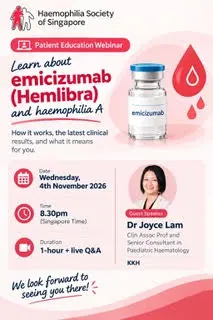
The Haemophilia Society of Singapore (HSS) recently hosted an educational webinar exploring emicizumab (Hemlibra), a non-factor treatment for people living with haemophilia A. The session was presented by Dr Joyce Lam, who shared an overview of how the treatment works, evidence from global clinical trials, and real-world experience from patients in Singapore.
Understanding Emicizumab
Traditionally, haemophilia A has been managed through regular infusions of factor VIII concentrate to prevent bleeding episodes. While effective, this comes with challenges like venous access, the frequency of infusions and, for some patients, the development of inhibitors.
Emicizumab works differently. Rather than replacing factor VIII, it is an antibody that mimics one of its functions by bringing two other clotting factors together to help the blood clot.
Administered as a subcutaneous injection rather than an intravenous infusion, it offers an alternative approach to bleed prevention.
What Does the Clinical Evidence Show?
Dr Joyce presented findings from several global clinical trials, including the global HAVEN studies, which demonstrated significant reductions in bleeding rates among people with haemophilia A, both with and without factor VIII inhibitors.
She also highlighted findings from studies involving younger children and infants, an important development given the challenges of administering regular intravenous treatment to very young patients.
Beyond reducing bleeding episodes, research has also explored how emicizumab may enable people with haemophilia A to participate more confidently in physical activities and sports.
Importantly, Dr Joyce also discussed the treatment’s safety profile, including potential complications and considerations when managing breakthrough bleeds. She emphasised that although emicizumab provides effective bleed protection, it does not eliminate the possibility of bleeding, and appropriate medical management remains important.
The Singapore Experience
A particularly relevant part of the presentation was the sharing of real-world data from patients treated in Singapore.
Dr Joyce presented findings from local experience involving both children and adults, showing significant reductions in bleeding rates following treatment with emicizumab. The data also demonstrated improvements among patients with and without inhibitors.
The session included a recorded from one of our community, a university student with severe haemophilia A who had previously been on factor treatment before switching to Hemlibra.
He described the practical differences the treatment had made, particularly the convenience of subcutaneous injections compared with finding a suitable vein for intravenous administration. He also spoke about feeling more confident participating in physical activities and going to the gym.
One of the participants in the call also shared his own experience of being on Hemlibra for several years, highlighting the reduction in breakthrough bleeds and the greater ease of administering treatment.
These personal accounts provided an important perspective alongside the clinical evidence, illustrating how treatment advances can affect not just bleeding outcomes, but everyday life.
Access and Affordability: An Important Consideration
The discussion also addressed questions around the availability and cost of Hemlibra in Singapore.
Although the treatment is registered and available in Singapore, it is not currently included on the Standard Drug List and does not receive the same MediShield Life and MediSave subsidies available for some conventional factor VIII treatments. Its cost can therefore be a significant barrier for patients who may benefit from it.
HSS shared that it has submitted a request to the Agency for Care Effectiveness (ACE) for Hemlibra to be considered as a subsidised treatment option for people with haemophilia A.
This is an important part of HSS’ broader advocacy efforts: ensuring that advances in treatment translate into meaningful and accessible options for our community.
As highlighted during the discussion, the patient voice matters. Alongside the clinical evidence and perspectives of healthcare professionals, the experiences and needs of people living with haemophilia must also be heard when decisions about treatment access are being considered.
Continuing to Learn and Share
We would like to thank Dr Joyce Lam for sharing her knowledge and experience, as well as the patients who generously contributed their personal stories.
Educational sessions such as this are an important part of HSS’ ongoing efforts to keep our community informed about developments in haemophilia care, while creating opportunities to better understand the treatment options available and the issues that still need to be addressed.
Ultimately, the goal is not simply to reduce bleeding, but to help people with haemophilia live with greater confidence, independence and freedom to participate in everyday life.